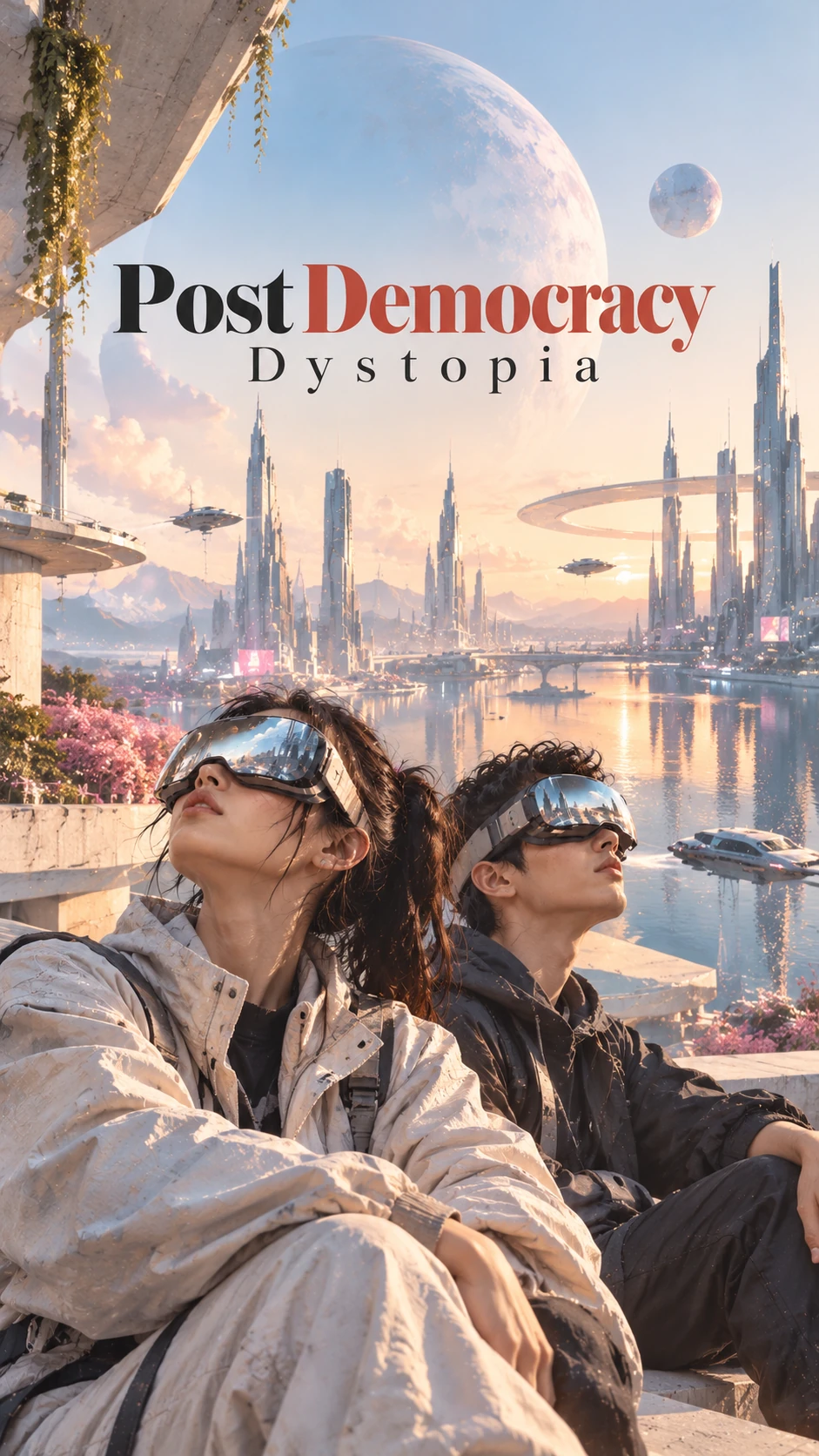
The last parliament was still in session when the people stopped listening.
Inside, politicians argued beneath the grand ceilings of a building designed to make power look permanent. Outside, an entire generation had begun to question why the building existed at all. Elections were still held. Political parties still issued manifestos. Presidents and prime ministers still delivered speeches about the future. But the future was already taking shape elsewhere, on millions of devices where citizens had begun experimenting with a different idea of democracy.
For centuries, representative democracy had rested on a practical limitation. Millions of people could not gather in one place to debate every law, examine every budget, or vote on every public decision. They needed representatives. Political parties organized their interests, parliaments negotiated their disagreements, and governments exercised authority in their name. It was an imperfect arrangement, but one that made democracy possible in large societies.
Artificial intelligence began to challenge that limitation.
A generation raised with intelligent machines started asking questions that previous generations had little reason to consider. Why elect a politician to represent your interests for five years when a personal AI agent could represent them every day? Why depend on party manifestos when an intelligent system could examine proposed laws, explain their consequences, and consult citizens before decisions were made? Why should political participation be reduced to an occasional vote when technology could make it continuous?
The idea acquired a name: agentic direct democracy.
In this imagined system, every citizen could have an autonomous AI agent capable of studying public policy, evaluating competing arguments, and participating in collective decisions according to the citizen’s instructions. People could intervene whenever they wished, change their preferences, or withdraw authority from their agents. Government would no longer depend entirely on elected intermediaries. Political power, at least in theory, could move directly between citizens and the systems responsible for carrying out their decisions.
The promise was extraordinary. So was the threat it posed to the political class.
The professional politician, once an essential link between the citizen and the state, now faced the possibility of becoming unnecessary. Political parties could lose their reason for existing. Parliaments might become expensive monuments to an earlier age of communication. Even presidents and prime ministers could find their offices reduced to ceremonial reminders of a time when governing required a human face.
There was something almost comic about the situation. Humanity had spent centuries fighting over who should occupy the highest offices of government. Now a younger generation was beginning to ask whether those offices should exist.
The politicians did not find the joke amusing.
They had survived revolutions, economic crises, wars, scandals, and countless predictions of their own downfall. They understood elections, protests, coalitions, and the careful management of public anger. But they had never faced a generation that questioned not merely their competence or honesty, but the need for their profession.
And so the resistance began.
Governments warned that AI-driven democracy would threaten national security. Political parties described autonomous civic agents as dangerous experiments. Parliamentary committees summoned technology developers for public hearings. New laws appeared in the language of public safety, digital responsibility, and institutional stability. Some concerns were legitimate. Others offered useful excuses for protecting the old order.
Police appeared at demonstrations demanding political reform. Surveillance systems identified organizers before protests could gather momentum. Bureaucracies delayed experiments in digital participation. Political leaders warned of chaos while using the machinery of the state to defend institutions that were steadily losing public confidence.
Meanwhile, political theatre became more elaborate.
There were televised debates, carefully staged confrontations, patriotic speeches, accusations of betrayal, and endless promises of renewal. Parties that disagreed about almost everything found common ground in defending the political system that sustained them. The public was invited to watch another election, another scandal, another parliamentary confrontation. The performance continued even as fewer people believed that the performers controlled the future.
The great irony was that institutions created to represent the people were now resisting the possibility that the people might represent themselves.
Yet the new generation had its own problems to confront.
An AI agent might understand a citizen’s political preferences, but understanding is not the same as judgment. A person might support lower taxes, better hospitals, stronger public services, and reduced national debt without knowing how to reconcile those demands. An intelligent system could calculate the trade-offs, but calculations could not decide what a society ought to value.
There were deeper questions. Who would build these agents? Who would train them? Who would control the networks through which billions of personal decisions became national policy? What would happen if the same corporations that already influenced public opinion came to operate the systems through which citizens exercised political power?
A democracy without politicians might still have rulers. They would simply be harder to see.
The danger was not that machines would necessarily become cruel. It was that their decisions could become so convenient, so efficient, and so difficult to challenge that people would gradually stop questioning them. A society might remove the corruption of human politics only to discover that it had replaced visible authority with invisible control.
And there was another possibility, more troubling than either side wished to admit. People might eventually grow tired of governing themselves. They might allow their agents to make decisions automatically, approving laws they had never read and policies they barely understood. What began as the greatest expansion of democratic participation in history could end as the most complete surrender of political responsibility.
The old system had asked citizens to trust politicians. The new one might ask them to trust machines.
Neither arrangement guaranteed freedom.
This is the world of Post-Democracy Dystopia, a future in which the struggle for democracy has moved beyond elections and political parties. Artificial intelligence has made an older political system appear increasingly unnecessary, but the institutions built around that system refuse to disappear. The generation demanding change believes technology can return power to ordinary people. The political establishment insists that dismantling its institutions would destroy democracy itself.
Both may be right about the dangers. Neither may be right about the solution.
The struggle is not simply between humans and machines. It is between two competing ideas of political authority: one based on representatives who claim to speak for the people, and another based on intelligent systems that claim to act on their behalf. Each promises freedom. Each creates new ways for power to escape public control.
The last human political parties are fighting for survival. They call it the defense of democracy. Their opponents call it the defense of privilege. Behind the speeches and demonstrations lies a question that neither side can answer with confidence: Can humanity use artificial intelligence to govern itself without eventually allowing artificial intelligence to govern humanity?
Perhaps the last parliament will not fall to a revolution, a military coup, or an angry crowd. Perhaps its final session will resemble every session before it, with politicians debating procedures, defending traditions, and arguing over who has the authority to decide.
Outside, the citizens will have moved on.
The building will remain. The flags will still fly. The guards will still stand at the gates. Somewhere inside, the last speaker will call the chamber to order.
And for the first time in centuries, nobody beyond its walls will be waiting for a decision.
The last political parties will not be fighting to save democracy. They will be fighting to save a world in which democracy still needs them.